
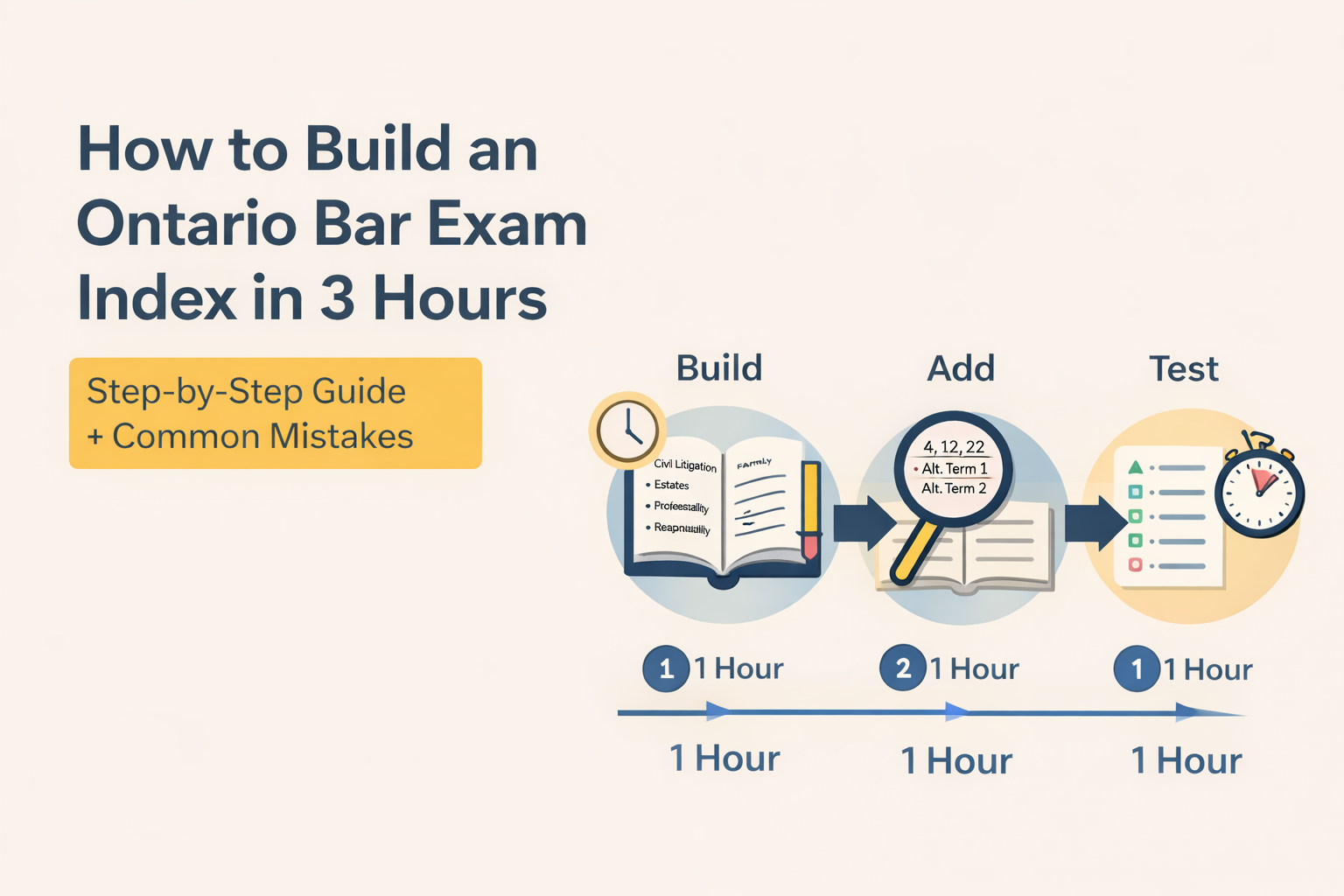
Building a strong index for the Ontario Bar Exam doesn’t need to take days or weeks.
In fact, the best-performing candidates build a clean, functional index in about 3 hours. Not because they rush, but because they understand what matters and what doesn’t.
This guide will show you:
The Ontario Bar Exam is open-book, but that doesn’t make it easy.
You’re answering:
Your index is not about memorizing law.
It’s about finding the right rule in seconds.
A bad index causes:
❌ Panic
❌ Time loss
❌ Guessing
❌ Missed easy questions
A good index does the opposite.
Here’s the truth most students don’t hear:
You do NOT need a 50-page index to pass.
You need:
Anything beyond that becomes clutter.
Goal: Create a clean framework not details.
Start with the big topics only.
Examples:
Write these as main index headers.
Under each section, add commonly tested concepts not everything.
Example (Civil Litigation):
👉 If a topic appears repeatedly in practice questions, it belongs in your index.
Don’t overthink structure.
✔ Alphabetical
✔ Clean
✔ Consistent
Complex systems slow you down.
Goal: Make your index functional not pretty.
For each entry:
Example:
Limitation Periods 4, 22
Avoid:
❌ Long page ranges
❌ Every mention of the topic
Think like the exam writer.
Add:
Example:
“Lawyer Duties” → also index under “Professional Responsibility”
This increases hit-rate during time pressure.
Goal: Stress-test your index before exam day.
This is where most students fail.
Do this:
If it takes more than 20–30 seconds, your index needs refinement.
Delete:
Your index should guide you not slow you down.
More entries ≠ better index.
Too many entries cause:
What works for one student may not work for you.
Your index must match:
If you haven’t done practice questions, you don’t know:
Index AFTER exposure to questions.
An untested index is a gamble.
If it hasn’t been used under time pressure, it’s not exam-ready.
BarBuddy was built for this exact process.
With BarBuddy, you can:
✔ Practice realistic Ontario-style questions
✔ Track how long it takes to find rules
✔ Identify which topics appear most often
✔ See where your index slows you down
✔ Refine your index using real data
Instead of guessing, you optimize your index based on performance.
You don’t need days to build a winning Ontario Bar Exam index.
You need:
Build it smart. Test it early. Refine it often.
With the right index and the right system like BarBuddy passing the Ontario Bar Exam becomes manageable, strategic, and repeatable.